Web and code: small business websites
See your site before you pay.
A one-page website for a sole trader or a small crew, built in the browser in one sitting. Live with its own domain for a yearly figure, or taken free.
Start buildingWho it is for
For the sole trader or small crew whose work comes from being found and being rung. A page that says who you are, what you do, where and when, and makes calling you one tap, without a designer, a project or a big bill.
Plumbers, electricians, builders, painters, roofers, landscapers, cleaners and handymen have a template written for the trade; any other business starts from the general one. The page carries what customers have said about you too, on your own domain, and texting or emailing you is one tap as well.
Nothing asked for until the site is in front of you
Choose a trade, a look and a colour. Type in the name, the number, the hours and the area, and the page builds as you go. The finished site is on the screen before any question of paying for it, and the decision is made looking at it.
How it works
Build it
Pick the trade, the template and the colours. Fill in the name, the number, the hours, the services and the area, and a few photos if there are any. The page builds itself as you go. No account; the draft saves on your device.
Check it
The finished page, as it will look on a phone and on a desktop, before anything is paid.
Get it live, or take it
We put it live: a domain registered in your name and pointed at the site, the hosting, the secure address, a check on your own phone, and the first year looked after. Or take the folder free and put it online yourself.
Example sites
Six templates, each shown on a business that does not exist, in a city that does. Open any of them.
Docket
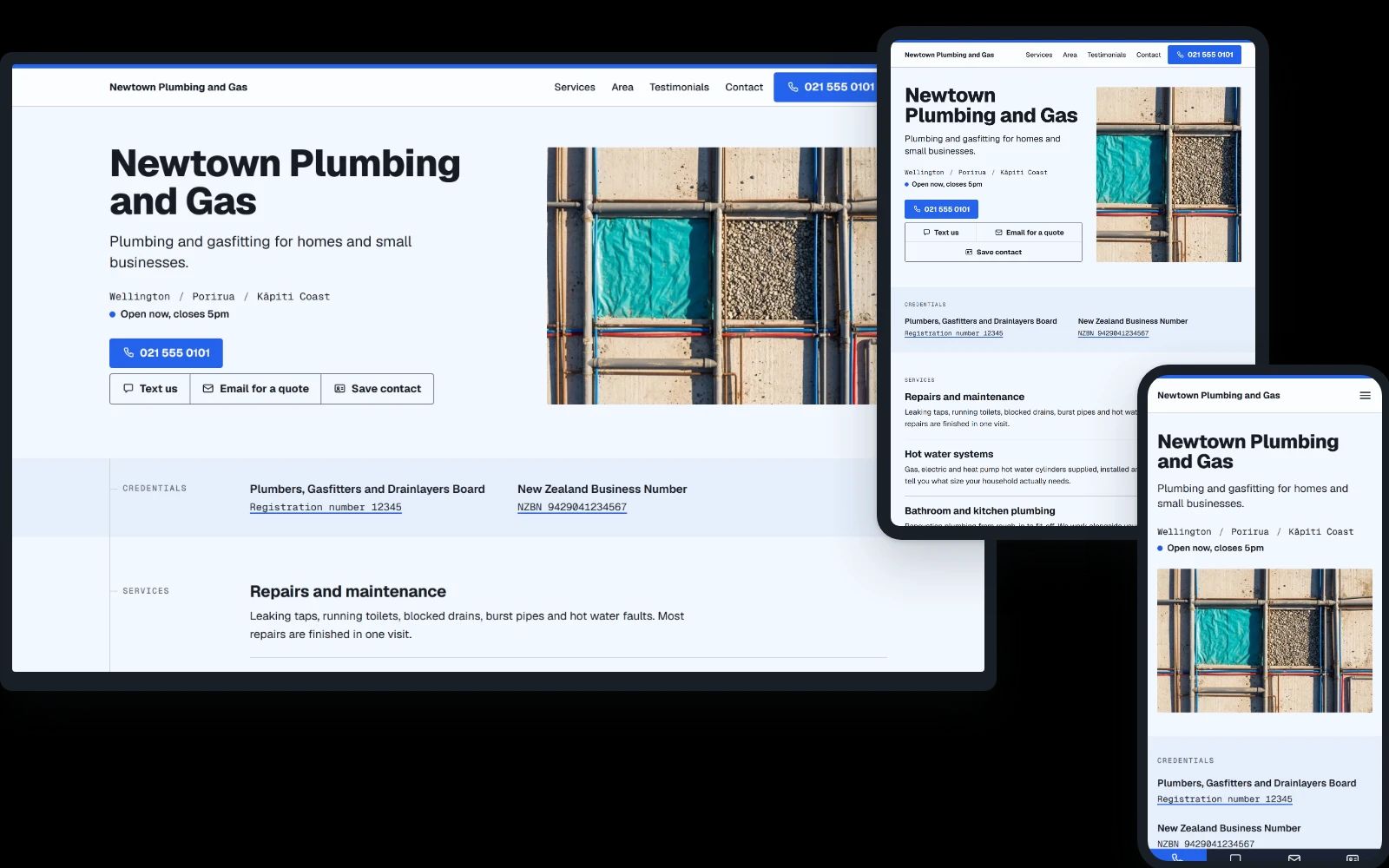
A job sheet to check: services, area and hours as plain rows, every figure in a typewriter face. See a plumber in Wellington.
Signboard
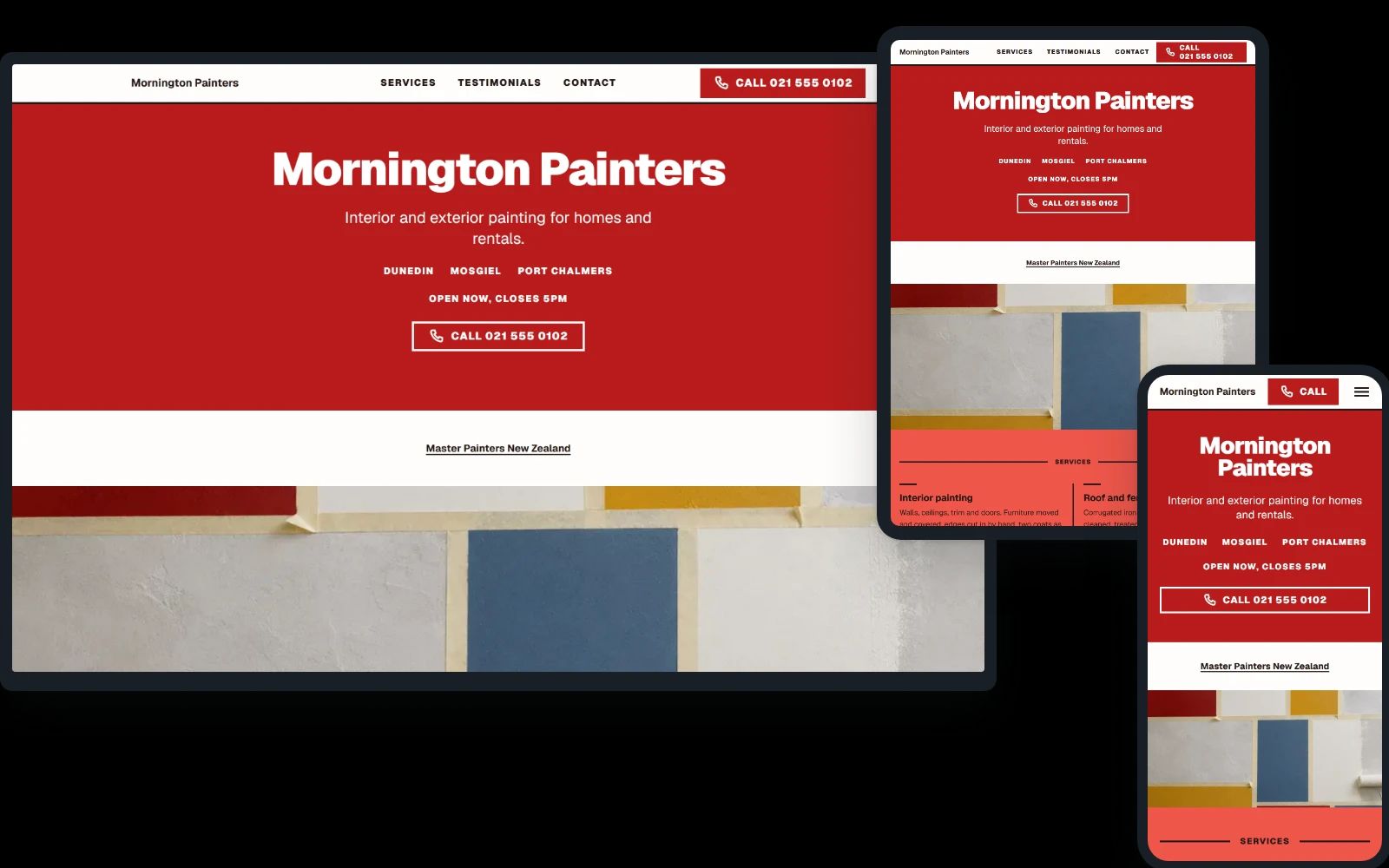
A sign to read: the name at full width on your colour, the services in two big columns under it, and as few words as the job allows. See a painter in Dunedin.
Editorial
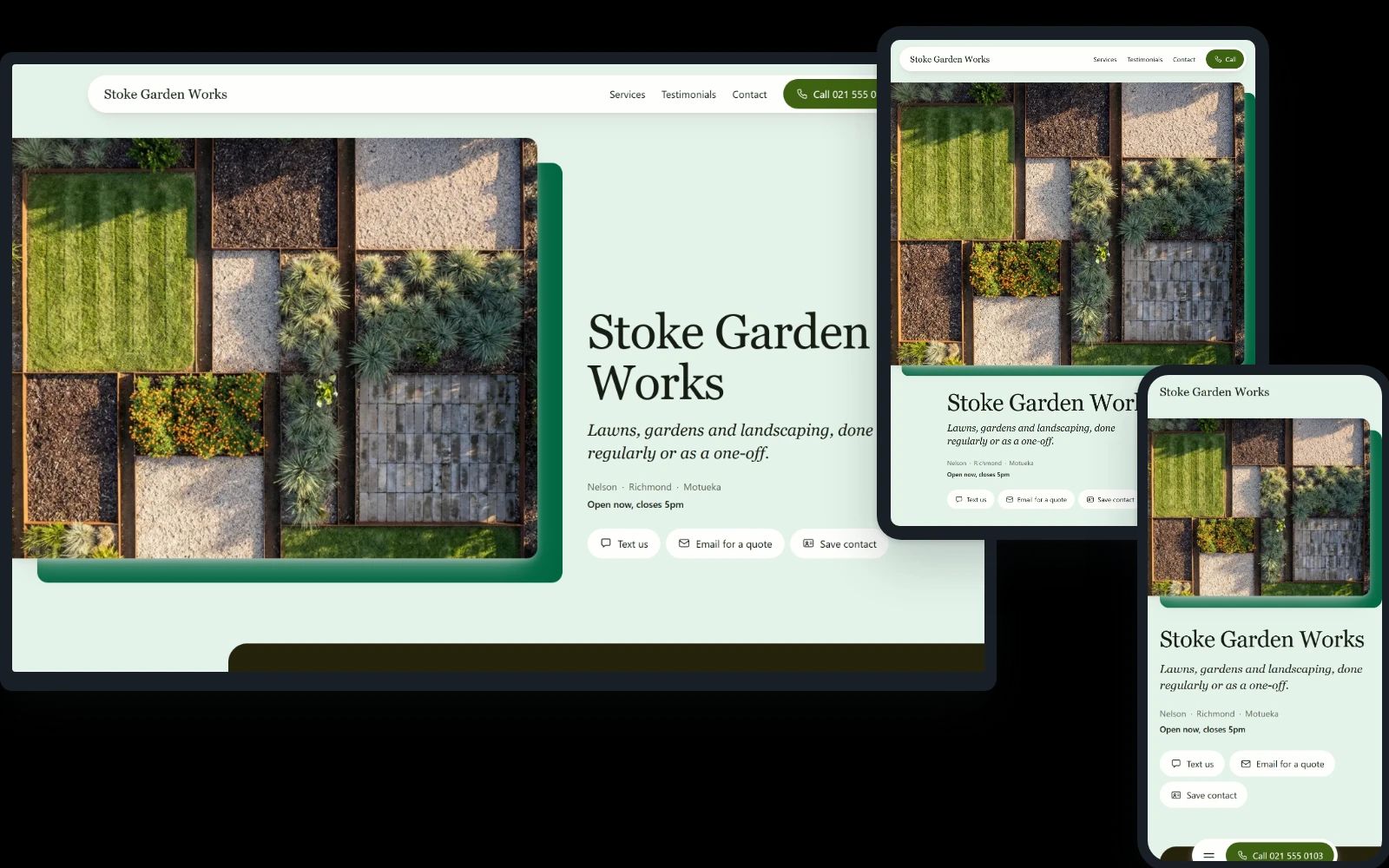
A spread to look at: one photograph laid large on a block of colour or timber, the name beside it, and a customer's words as the opening proof. For the trade with one good photo to show. See a landscaper in Nelson.
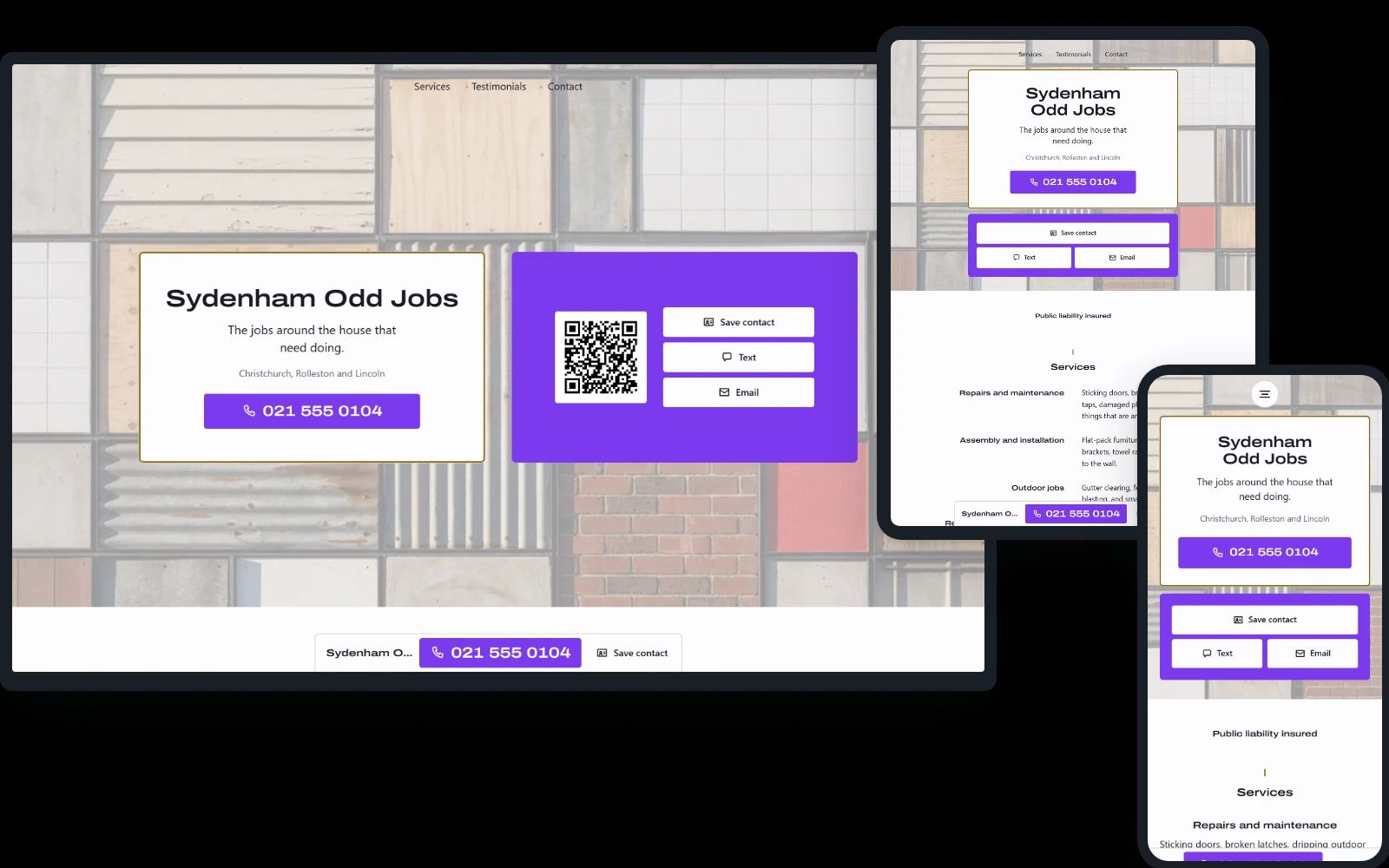
Calling Card
The business card itself, centred: name, number, a Save contact button and a QR code, laid on a faded picture. Needs no photos and no reviews, so it is the one to start with when there is little to show yet. See a handyman in Christchurch.
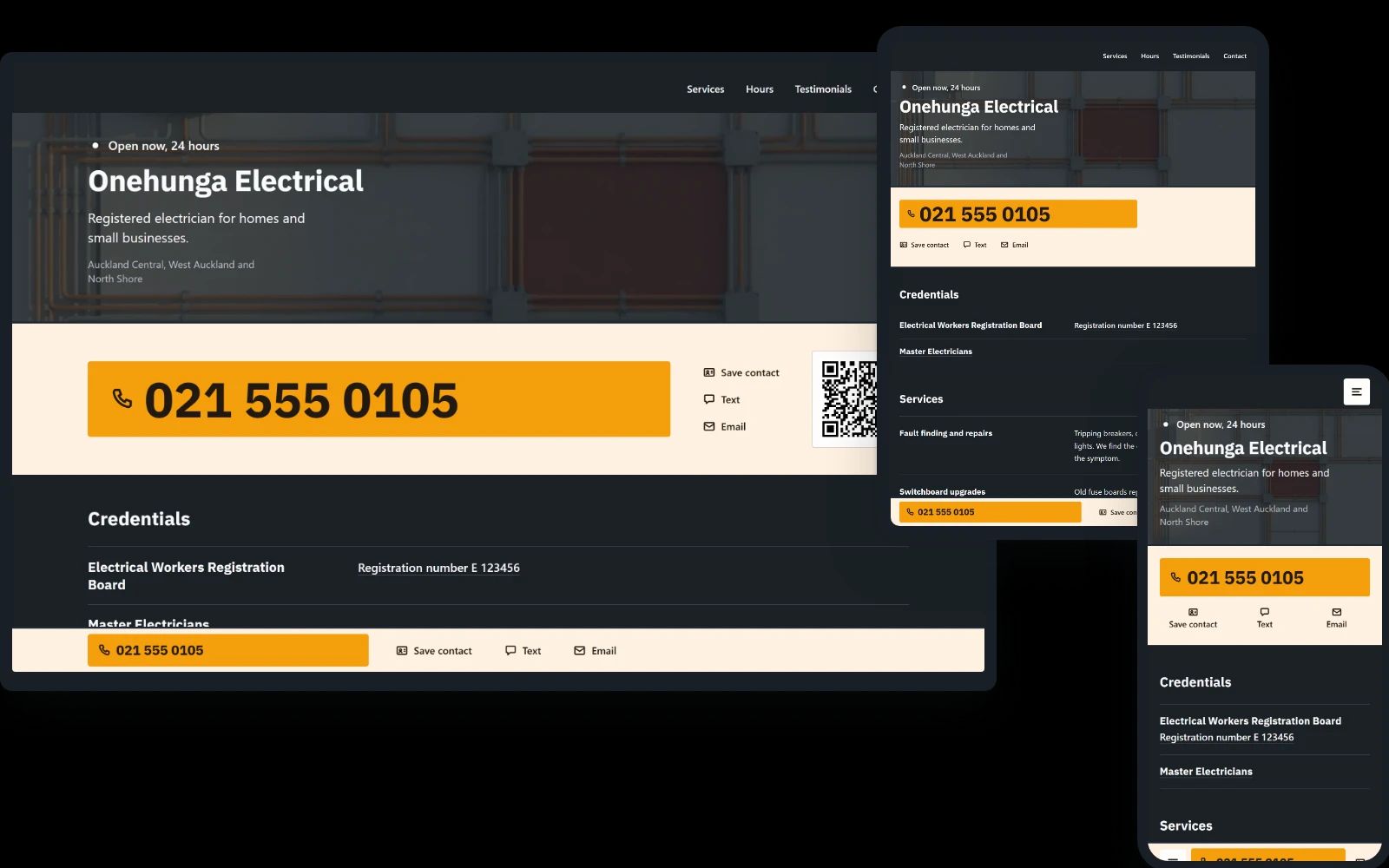
After Hours
Dark, built for urgency: open now and Call fill the first screen, and the hours are drawn so people can see when you answer. For the plumber or electrician who picks up out of hours. See an electrician in Auckland.
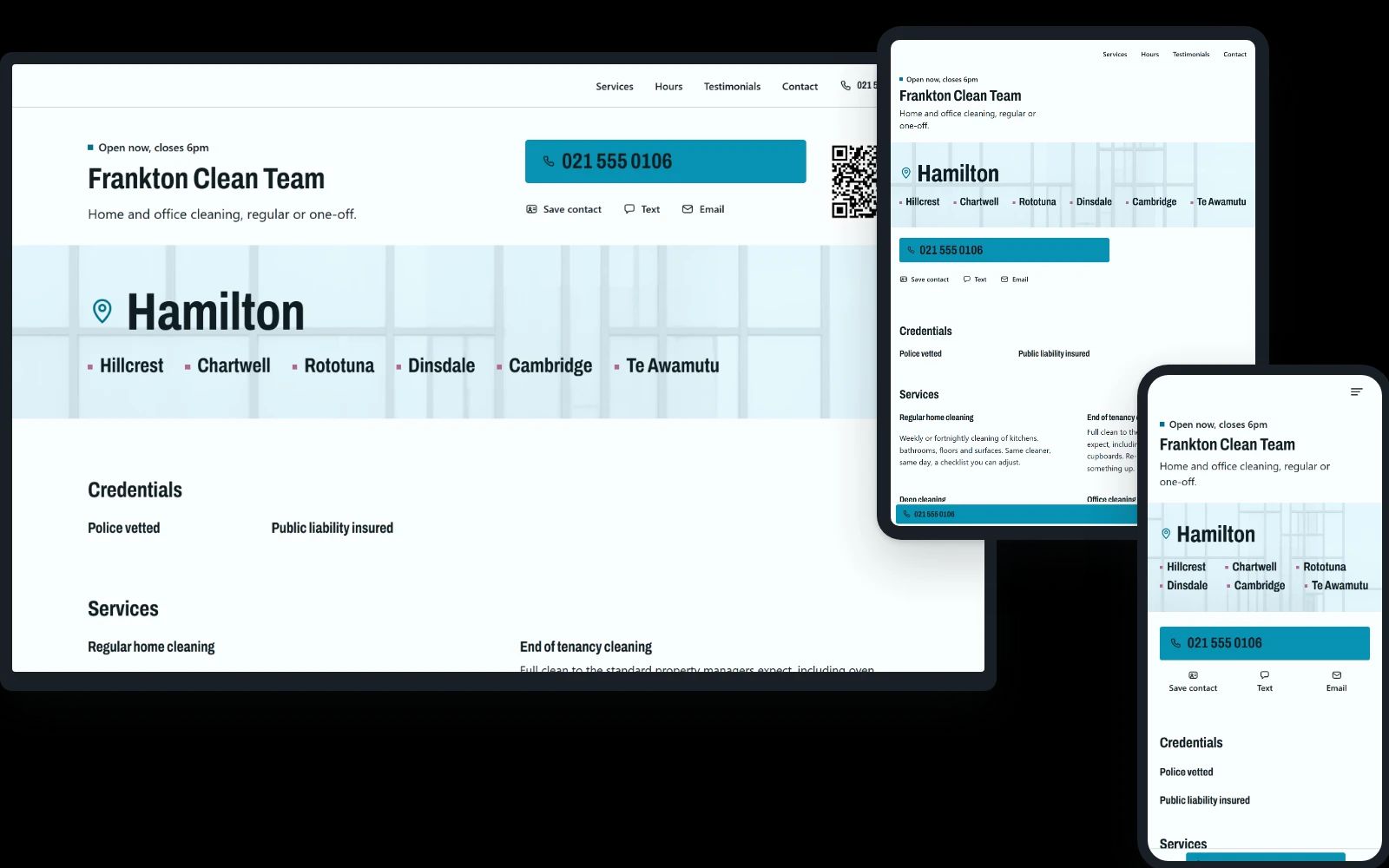
Patch
Led by where: the suburbs you travel to, set large under the name, so people find their own at a glance. For the trade that comes to the customer. See a cleaner in Hamilton.
Free, or hosted
All prices in New Zealand dollars. The full terms: terms and licence, hosting terms.
What it deliberately does not do
One page, not a site of pages. No shop, no bookings, no forms, no visitor tracking, no cookies. A page that says who you are, what you do, where, when, and how to call.
Need more than one page? That is a designed website, which we also do. Web design and development.
Written for the trades
A preset for each of the eight trades fills the page with words that already sound right, so most of the work is changing a name and a number. Everything is yours to rewrite.
What to add after
A domain is a website and an email address. With a Google Business Profile and Search Console beside it, a small business has its whole basic setup, for very little.
On the builder's last step you can tick the ones you are curious about, and we include them when we get in touch. No prices there yet, so nothing is added to the order.
- Email on your domain
- [email protected] instead of a Gmail address, on the phone you already carry. We set it up on Google Workspace, or Microsoft 365 if that is where you work, and you pay them their monthly fee. Almost every trade should have this.
- A Google Business Profile that agrees with the site
- The listing that puts you on the map and in the local results. We set it up, or check the one you have, so the hours, the areas and the services match the site word for word. The site already carries all three in the form Google reads.
- Search Console
- We tell Google the site exists and connect the reports, so you can see the search terms people found you by. Free from Google.
- Photographs of your work
- The one thing a library picture can never be. A half day on your jobs gives the site, the profile and the ads the same real pictures.
Questions
- Domains
- One domain is included in the $300 and the $99: a name that is free to register at its standard price, in a common ending such as .nz, .co.nz or .com. A name someone already owns, or one a registry sells as premium, costs the difference. A domain you already own stays where you bought it. We point it at the new site, a change we do with you, and we move your email settings across first so nothing stops working.
- Ownership and the licence
- Your content is yours: the name, the words, the photos, the logo, the reviews. The template, the code and the library pictures are Train Effect’s, with a free, permanent licence to use them for your own business’s website: host it anywhere, change it, keep it. The domain is registered in your name.
- Changes
- A live site does not change by itself. Ask for a change and it is made for $30; most take fifteen minutes. Bigger jobs are quoted first, at $120 an hour, and nothing is charged until you agree. Fixes that keep the site working are part of hosting and cost nothing.
- Leaving
- Leave at any time. You get the site as a folder to put online anywhere, and the domain’s transfer code, free. The licence carries on.
Start building.
Free to use, no account, and nothing to pay until the site is in front of you.
builder.traineffect.co.nz